Collet Register earns referral commissions from qualifying purchases through our links at no additional cost to you. Read our affiliate earnings & merchant referral policy
Framing budget watchmaking tools through exact blade-to-caliber slot geometry and metal-on-movement contact safety, giving modders clear dimensional boundaries for every repair task.
Quick Compatibility Verdict
Selecting the correct watch case opener depends strictly on the architecture of the case back. Press-fit backs require a razor-thin bevel knife, multi-notch screw backs demand pinned adjustable wrenches, and flat circular sport cases can often be handled cleanly with friction balls.
1. Snap-Back Cases: Pry Knives
For snap-on or pressure-fitted case backs found on standard dress pieces (such as entry-level quartz calibers), a fine-beveled knife blade is required to locate the micro-lip slot.
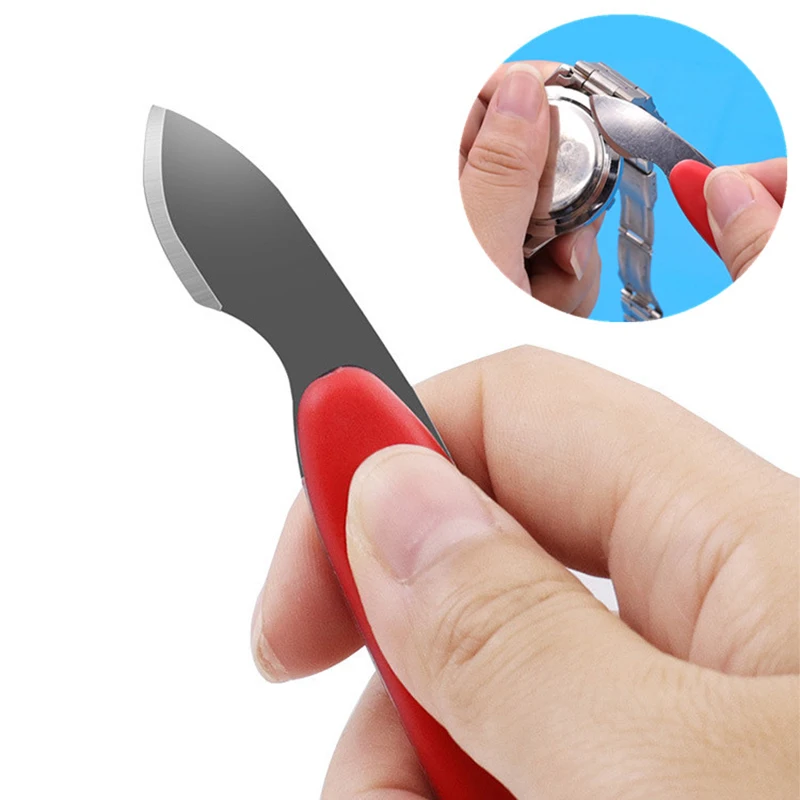
Specifications & Limitations: The blade edge must feature a wedge profile thin enough (typically under 0.40mm at the primary bevel apex) to slip beneath the overhang without scoring the case mid-body. Soft handles offer comfort, but ensure the steel tang is fixed rigidly to prevent blade rotation under torque.
2. Threaded Case Backs: Two and Three-Claw Wrenches
Water-resistant sport watches and dive pieces utilizing calibers like the Seiko NH35 or Miyota 8215 feature threaded screw-down backs punched with square slots, circular holes, or perimeter notches.


Suitability & Geometry: Two-claw wrenches offer fast adjustment for occasional battery swaps, but three-claw variants provide equilateral clamping distribution, reducing the risk of pin slippage across high-torque seals. Ensure the hardened steel pins match the exact diameter of the case back slots (typically 1.00mm to 1.50mm).
3. Friction and Sticky Backs: Rubber Balls
When dealing with smooth, unnotched screw-back cases or delicate collector pieces where metal jaws could mar the perimeter finish, high-friction elastomeric spheres apply uniform rotational force.

Operational Limit: Friction balls are limited by grip limits and hand strength. They cannot overcome heavily oxidized or thread-locked waterproof gaskets tightened to industrial factory specs, making them ideal strictly for light-duty or frequently serviced snap-free variants.
Comparative Specifications Matrix
| Tool Type | Target Interface | Primary Risk Factor | Caliber Suitability |
|---|---|---|---|
| Pry Knife | Snap-fit bezel slot | Slip-strike into balance wheel | Basic quartz (e.g. Ronda, PC21) |
| 2/3-Claw Wrench | Notched screw rings | Pin deflection / case scratching | Mechanical automatic (NH35, ETA 2824) |
| Rubber Ball | Smooth screw-back surface | Insufficient torque leverage | Lightweight daily wearers / dive-style |